
How to Recover Permanently Deleted Files in Windows 10/11

A few years ago, I was tidying up my workspace late at night and did the unthinkable: I emptied the Recycle Bin while a client’s project folder was still inside. My heart hit the floor. I had been told that “permanent” deletion was the end of the road, but that night, I learned otherwise. In the world of data architecture, “permanent” is often a misnomer. If you act before your system overwrites the physical sectors of your drive, you can actually reverse the clock. Learning how to recover permanently deleted files from pc is essentially a high-stakes race against time and system automation. Whether you’re dealing with a simple accidental Shift + Delete or a complex partition failure, your data is usually still there—it’s just invisible. This guide breaks down eight proven solutions I’ve used to regain access to irreplaceable documents and photos.
The Golden Rule: Stop Everything Immediately
Before we get into the “how-to,” we have to talk about the one thing that will ruin your chances: Disk Overwriting. When you delete a file, Windows doesn’t actually scrub the bits and bytes off your drive. Instead, it modifies the file system table to mark that space as “Available.” To the computer, that space is now a blank canvas. If you keep browsing the web, downloading apps, or even just leaving the PC idle, Windows will eventually write new temporary files over your lost data. To give yourself the best shot, shut down unnecessary programs right now. If your lost files were on the C: drive, the safest move is to stop using that PC entirely and run your recovery from a “Live USB” or a secondary computer.
Compatible Table of 7 Methods
| Method | Compatible OS | Requires Backup? | Cost |
| Recycle Bin | All Windows | No | Free |
| Undo Delete | All Windows | No | Free |
| WinfrGUI | Windows 10+ | No | Free |
| File History | Windows 8+ | Yes | Free |
| Google Drive | All Windows | Yes (G Suite) | Free |
| Backup & Restore | Windows 7+ | Yes | Free |
| Windows File Recovery | Windows 10+ | No | Free |
Method 1: The Recycle Bin Audit
If you have just deleted a file, your chances of recovery are highest if you act before leaving the current window or restarting the system. The fastest way to undelete files is the Recycle Bin. Note that this does not apply to files purged via Shift + Delete.
- Open the Recycle Bin from your desktop.
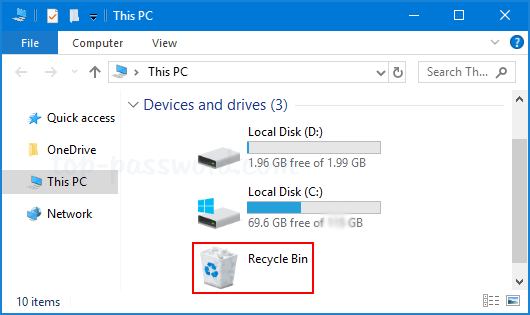
- Use the search bar to locate your file or sort by Date Deleted.
- Right-click the file and select Restore.
Method 2: The “Undo Delete” Shortcut (Ctrl + Z)
Windows maintains a volatile “history stack” of recent file actions within the File Explorer.
- Navigate to the folder where the deletion occurred.
- Press CTRL + Z on your keyboard.
- Alternatively, right-click an empty space in the folder and select Undo Delete. Note: This history is wiped if you restart your PC or close the active window.
Method 3: Professional Extraction via WinfrGUI
When the Recycle Bin is empty, you must bypass the OS and perform “File Carving.” While Microsoft’s official Windows File Recovery tool is command-line based, WinfrGUI provides a professional-grade graphical interface to make the process more efficient and less prone to user error. Step-by-Step Execution are as follows:
- Preparation: Download WinfrGUI and install it on a different drive (e.g., if data was lost on C:, install on D: or a USB).
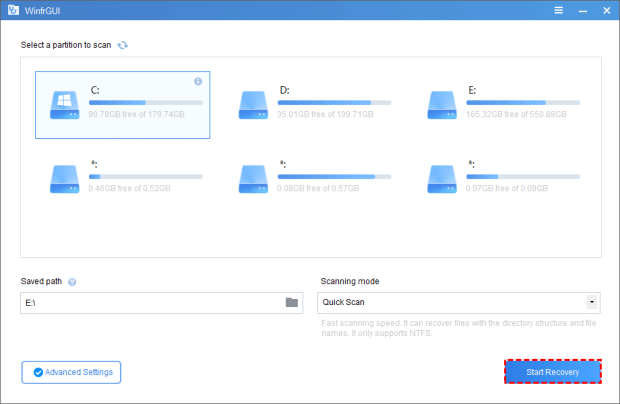
- Drive Selection: Launch the app and select the partition that contained the deleted files.
- Destination Path: Select a folder on a separate physical drive to save the recovered data.
- Mode Selection: * Quick Scan: Best for recently deleted files on NTFS drives.
- Deep Scan: Necessary for drives that were formatted or have been used for a while since the deletion.
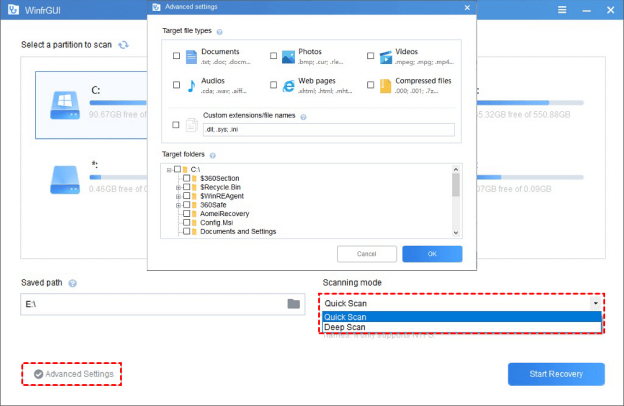
- Advanced Settings: Click the “Settings” icon to filter by specific file types (e.g., .jpg, .pdf, .docx) to speed up the process.
- Execution: Click Start Recovery. Once the process reaches 100%, click View Recovery to inspect the salvaged files.
Method 4: Windows File History
If you have implemented a proactive backup strategy, these methods offer the most reliable path to full data restoration. This feature automatically backs up data from your Libraries, Desktop, and Favorites to an external location.
- Type Control Panel in the Start menu and launch it.
- Go to System and Security > File History and click Restore personal files.
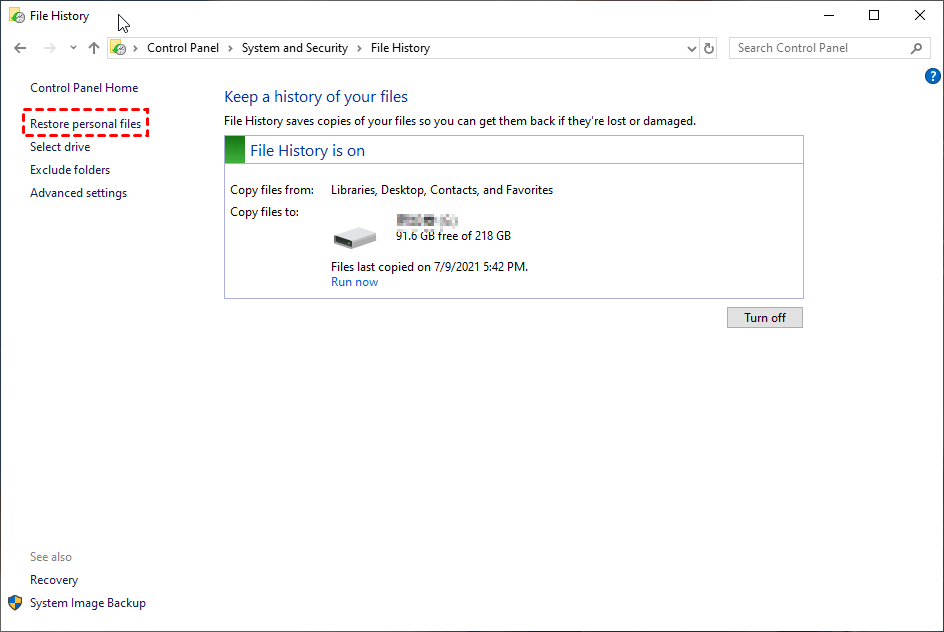
- Browse the snapshots and click the Green Button to restore the target file to its original home.
Method 5: Google Drive
If your PC is synced with a G Suite account, you can recover data from the cloud-side Admin Console.
- Log in to the Google Admin Console and go to Users.

- Find your account and click Restore Data.
- Select Drive as the destination and confirm the recovery range.
Method 6: Windows Backup & Restore
This is a deeper recovery method used to roll back system states to a previous point in time.
- Go to Settings > System > Recovery and select Restart now.
- Navigate through Troubleshoot > Advanced options > System Image Recovery.
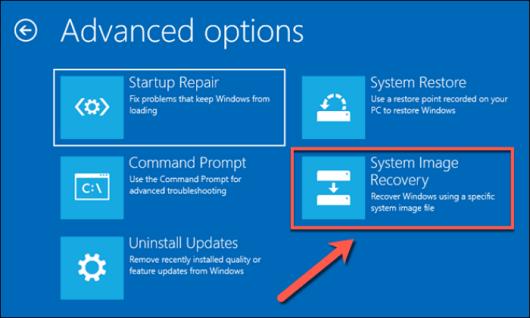
- Choose your most recent system image backup to restore previous versions of your files.
Method 7: Windows File Recovery (Built-in App)
If you are comfortable with a Command Prompt, use Microsoft’s official recovery app.
- Download Windows File Recovery from the Microsoft Store.
- Launch the app and enter the command:
winfr source-drive: destination-drive: [/mode] [/switches]
- For PDFs:
winfr C: E: /regular /n *.pdf
- For Deep Scan:
winfr C: E: /extensive /n *invoice*
- Enter Y to confirm and begin the extraction.
Troubleshooting & FAQ
Q1: Why are my recovered files corrupted?
This usually means a new file was partially written over the old one. Once those sectors are replaced, the original data is lost forever.
Q2: Is SSD recovery harder than HDD?
Yes. Modern SSDs use TRIM to actively wipe “available” space. Your window for recovery on an SSD is much smaller than on a traditional hard drive.
Q3: Can I recover data from a formatted drive?
Usually, yes, if it was a “Quick Format.” A “Full Format” writes zeros to the entire drive, which makes data recovery virtually impossible.
Q4: Is it safe to install recovery software on the same drive?
Absolutely not. You risk overwriting the very files you’re trying to save. Always use a USB or a secondary drive for installation.
Q5: How can I prevent such data loss in the future?
Follow the 3-2-1 Rule: Keep 3 copies of data, on 2 media types, with 1 copy off-site. Additionally, ensure “File History” is enabled for automatic hourly backups.
Q6: What if my drive is making a clicking noise?
This suggests mechanical failure. Stop using the drive immediately and consult a professional hardware repair lab, as software cannot fix physical damage.
Summary
Mastering how to recover permanently deleted files from pc is a high-stakes race against time. Because Windows merely hides deleted data rather than destroying it instantly, user-friendly utilities like WinfrGUI can effectively pull your files back from the brink. However, technical hurdles like SSD TRIM commands and disk overwriting mean that once the Recycle Bin is empty, success is never a guarantee. Ultimately, the only way to ensure total data safety is through redundancy. By implementing a 3-2-1 backup strategy and automated cloud syncing, you can transform a potential digital disaster into a minor, easily fixable inconvenience.
🔗 More Tutorials:
 MyRecover
 FoneTool
